

Art and Music Therapy Healing Through Creative Expression
Express, release, and rediscover the colours of your inner song.
Creativity as Medicine
Since ancient times, humans have turned to art and music not only for beauty but for healing. Both have the power to reach places in the heart and mind that words often cannot. In the context of integrative therapies, Art Therapy and Music Therapy are structured approaches that use creative expression as tools for emotional healing, self-discovery, and inner balance.
Art and music bypass rational analysis and connect directly with the limbic system — the brain’s emotional center. This makes them especially effective in unlocking blocked emotions, soothing stress, and fostering resilience. Whether through painting, drawing, sculpting, singing, or listening deeply to sounds, these therapies allow a person to engage in a process of inner dialogue, release, and transformation.
Art Therapy: The Canvas of the Inner World
Art Therapy uses visual arts as a pathway to self-understanding and healing. The focus is not on artistic skill or producing “beautiful” art, but on the process of creation. By working with colour, form, and texture, emotions that may be unconscious or difficult to verbalize can surface safely.
Research shows that Art Therapy can:
- Reduce symptoms of anxiety, depression, and trauma by providing a safe outlet for expression (Stuckey & Nobel, 2010).
- Enhance emotional regulation and self-esteem, especially in children and adolescents (Slayton, D’Archer, & Kaplan, 2010).
- Support people living with chronic illness by reducing pain perception and improving quality of life (Monti et al., 2006).
Art Therapy is therefore a bridge between the inner world and outer experience, helping individuals see and reshape their own stories.
Music Therapy: Healing with Sound and Vibration

In melotherapy, music becomes medicine, rhythm becomes balance, and every sound is a step toward harmony.
Music Therapy or Melo – therapy works with the vibration of sound, rhythm, and melody. Since ancient times, music has been recognized as a universal language capable of touching the human spirit in ways that words cannot. In modern integrative health, melo – therapy is a structured approach, designed to promote well-being on physical, emotional, cognitive, and spiritual levels.
Scientific evidence highlights that Music Therapy can:
- Lower stress hormones and reduce blood pressure and heart rate, supporting cardiovascular health (Bradt & Dileo, 2014).
- Improve mood and social interaction, particularly in individuals with depression or dementia (Leubner & Hinterberger, 2017).
- Enhance pain management and promote relaxation during medical treatments or recovery (Garcia-Gil et al., 2020).
Because music reaches the nervous system directly, it can calm agitation, uplift sadness, or reawaken vitality — often within minutes.
In melo – therapy, music is not only listened to but experienced. Sessions may involve:
- Listening to selected pieces of music.
- Singing or vocal toning mantras.
- Music chakra activation
These activities stimulate the nervous system, regulate emotions, and create a state of resonance between body and mind. Scientific research shows that melo – therapy lowers stress hormones, improves cardiovascular and respiratory function, enhances memory and attention, and supports emotional regulation.
Therapeutic Benefits
- Stress and anxiety reduction: calming the nervous system and lowering cortisol levels.
- Pain management: music reduces pain perception and supports recovery.
- Emotional expression: music allows safe release of emotions such as sadness, anger, or grief.
- Social connection: group music-making strengthens bonds and fosters communication.
- Cognitive support: helpful in dementia, neurological rehabilitation, and learning disorders.
Integration in Our Programs
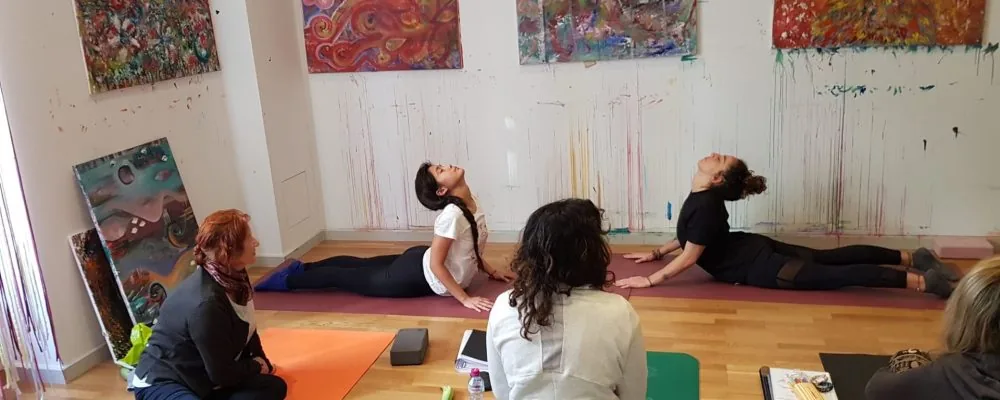
At Sundari Integral Yoga© School, we see Art and Music Therapy as essential complements to practices like Meditation, Yoga, Qigong, or Do In. They provide a space where the soul can express itself freely, where unspoken emotions can be acknowledged and released, and where joy can naturally arise.
These therapies are especially valuable for:
- Stress and burnout recovery.
- Emotional trauma and grief.
- Enhancing creativity and self-confidence.
- Building resilience in chronic illness.
- Cultivating a sense of play, spontaneity, and inner freedom.
Our art retreats invite participants to rediscover their creative essence, whether through a brush, a piece of clay, a drumbeat, or a song. No artistic experience is needed — only openness to the journey.
In essence, Art and Music Therapy are paths of self-healing where creativity becomes medicine, sound becomes balance, and expression becomes liberation. They remind us that healing is not only about removing pain but also about reconnecting with the joy, beauty, and harmony that are already within us.
Sources
Bradt, J., & Dileo, C. (2014). Music interventions for mechanically ventilated patients. Cochrane Database of Systematic Reviews, 2014(12), CD006902. https://doi.org/10.1002/14651858.CD006902.pub3
Bradt, J., Dileo, C., Magill, L., & Teague, A. (2016). Music interventions for improving psychological and physical outcomes in cancer patients. Cochrane Database of Systematic Reviews, 2016(8), CD006911. https://doi.org/10.1002/14651858.CD006911.pub3
Garcia-Gil, M., Climent, E., Hernández-Moreno, M., & Ros-Sanjuan, A. (2020). Effects of music therapy on pain and anxiety in patients undergoing hemodialysis: A systematic review. Journal of Renal Care, 46(4), 230–239. https://doi.org/10.1111/jorc.12326
Leubner, D., & Hinterberger, T. (2017). Reviewing the effectiveness of music interventions in treating depression. Frontiers in Psychology, 8, 1109. https://doi.org/10.3389/fpsyg.2017.01109
Stuckey, H. L., & Nobel, J. (2010). The connection between art, healing, and public health: A review of current literature. American Journal of Public Health, 100(2), 254–263. https://doi.org/10.2105/AJPH.2008.156497
Ready to Begin Your Journey?
Explore our programs, retreats, and classes to find the perfect fit for your path
View Prices & Packages